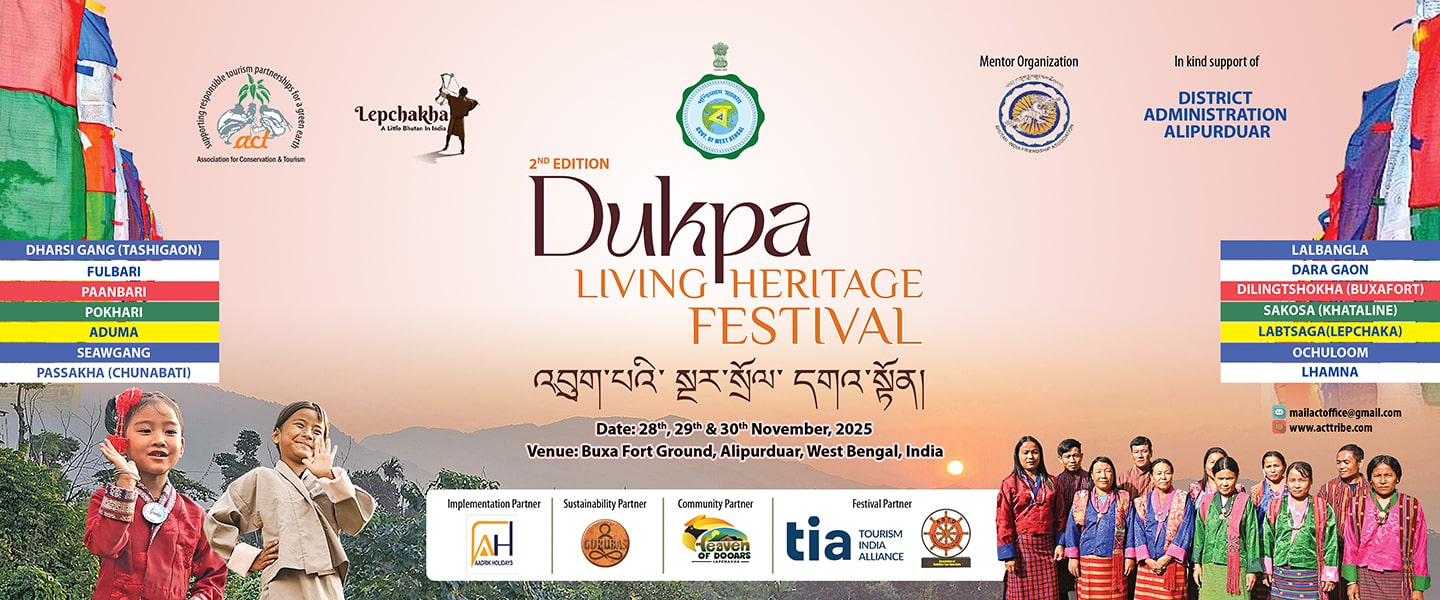
The Dukpa Living Heritage Festival is a vibrant celebration dedicated to the preservation and promotion of the rich cultural heritage of the Dukpa community. This festival aims to showcase traditional customs, arts, crafts, music, and dance, providing an immersive experience for participants and fostering a deeper appreciation of Dukpa heritage. Through a term exposer and survey with the help of experts we have realize that there has been deterioration in the ICH (Intangible Cultural Heritage) of the Dukpa communities hence during the festival we look forwards to bring cultural experts groups and ICH experts from Bhutan to exhibit and also teach the local Dukpa communities in the process.
Objectives
- Cultural Preservation- To safeguard and promote the traditional customs, practices, and arts of the Dukpa community.
- Community Engagement- To bring together members of the Dukpa community and the broader public in a shared celebration of culture and heritage.
- Sustainable Tourism Promotion- To attract tourists and cultural & natural enthusiasts, enhancing the region's profile as a responsible tourism destination.
- Educational Outreach- To educate younger generations and the all the villagers about their heritage, culture & traditions ensuring its continuity.
- Economic Development- To provide economic opportunities for local tourism stakeholders, artisans, performers, and craftsman through increased visibility and sales.
History:- The Sinchula Treaty and the Treaty of Punakha highlight the historical tensions between Bhutan and British India during the 19th and early 20th centuries. The annual celebration of the Sinchula landscape commemorates the Sinchula Treaty, which ended prolonged hostilities marked by the Duar War of 1864-1865. The Duar War led to Bhutan's defeat and the cession of the Assam Duars, Bengal Duars, and Dewangiri territory to British India. The Treaty of Punakha, signed on January 8, 1910, at Punakha Dzong, modified the Sinchula Treaty to reflect the evolving relationship between the newly consolidated Kingdom of Bhutan and British India. These treaties underscore the historical and geopolitical significance of the Sinchula landscape, pivotal in the trade and administrative interests of the period.
Geography:- Perched at an altitude of about 3,500 feet, Lepchakha offers panoramic views of the Bhutan hills and the surrounding Dooars plains. It is located within the Buxa Tiger Reserve,under the Alipurduar district of west Bengal,India providing a lush, forested landscape that is both serene and breathtaking.
Culture:- The cultural tapestry of Lepchakha is predominantly influenced by the Dukpa tribe, known for their unique language, folklore, and traditions. The community is deeply connected to nature, with customs and festivals that celebrate their ancestral heritage and the natural world. Nature :- Lepchakha is a nature lover's paradise, characterized by dense forests, diverse flora and fauna, and scenic beauty. The region is part of the Buxa Tiger Reserve, home to a variety of wildlife including tigers, elephants, and numerous bird species. Its pristine environment offers a tranquil escape from urban life.
Mission:- We are fortunate to have these rich cultural and natural assets in our district. Tourism stands as the sole viable means of generating income, given the absence of alternative employment opportunities. Due to limited local job prospects, many young people are compelled to leave the village in search of employment in Bhutan and other parts of India, leading to a gradual erosion of their cultural heritage.
Our mission is to preserve and promote this rich cultural, traditional, and natural heritage, ensuring that it remains vibrant and intact. By fostering responsible tourism, we aim to provide a sustainable livelihood for the local community. This approach not only safeguards their traditions but also empowers them economically, enabling them to stay connected with their roots while participating in a sustainable economic model. Through this endeavor, we hope to create a harmonious balance between cultural preservation and economic development, ultimately enriching the lives of the local populace.
Vision:- We are dedicated to developing a model village for responsible tourism in Asia. Our goal is to create a sustainable tourism framework that not only preserves the cultural and natural heritage of the region but also promotes economic stability for the local community. By implementing best practices in responsible tourism, we aim to set a benchmark for other villages and regions across Asia. This involves fostering community involvement, ensuring environmental conservation, and promoting cultural authenticity. We strive to create an immersive and enriching experience for visitors, allowing them to engage with the local culture in a meaningful way while contributing to the well-being of the host community.
Through this initiative, we are committed to demonstrating that tourism can be a powerful tool for sustainable development, fostering a deeper appreciation for cultural diversity and environmental stewardship. By achieving this vision, we hope to inspire similar efforts in other parts of Asia, ultimately contributing to a more sustainable and equitable tourism industry.